


Cold email has a reputation problem—and honestly, it’s earned. For most people, an unsolicited email isn’t an opportunity; it’s a nuisance. As inboxes get more crowded and AI-generated templates flood the market, the line between “outreach” and “spam” has never been thinner.
In episode five of Outfoxed, Adam Goldfarb, founder of Transcendence Audio, shares a refreshingly blunt take on why most cold email fails—and what actually works instead. His philosophy isn’t about clever copy or sending more emails. It’s about respect, relevance, and restraint.
If you’re a founder, marketer, or salesperson wondering how to write cold emails that don’t feel spammy, these lessons might completely change how you approach outreach in 2026.
Cold Email Doesn’t Have to Mean Spam
Adam offers a simple but powerful redefinition of spam. Spam isn’t defined by whether an email is cold—it’s defined by whether it’s a nuisance.
“If it’s just part of a campaign that’s sent out en masse,” Adam explains, “and the result is that email is a nuisance, then that categorically is spam.”
This framing forces a mindset shift. Instead of asking, “Will this convert?” the better question becomes: “Have I earned the right to interrupt this person?”
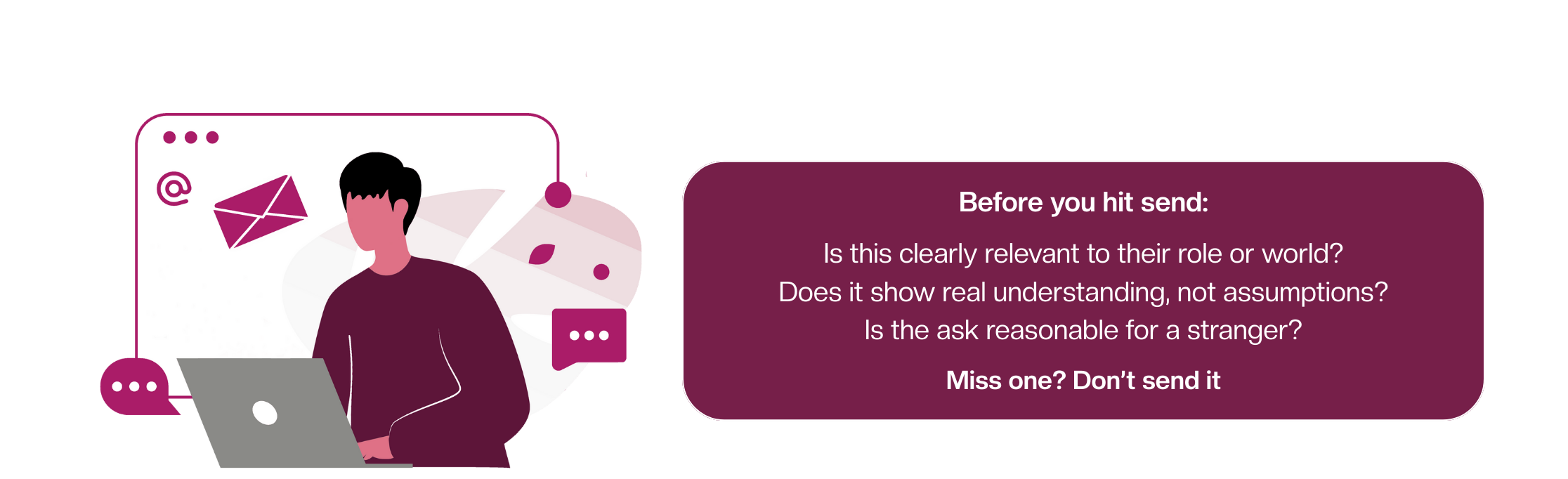
Before hitting send, apply what we’ll call the Nuisance Test:
- Is this clearly relevant to the recipient’s world?
- Does it show understanding, not assumptions?
- Is the ask reasonable for someone who doesn’t know me?
If your email can’t score high on all three, it’s probably better left unsent. In practice, this means starting small—30 to 50 highly intentional emails instead of thousands sprayed across a list.
Go 80/20: Research First, Writing Second
One of Adam’s most counterintuitive insights is also one of the most important: great cold emails are mostly written before you write them.
“I spend 80% of my time researching and 20% writing,” he says.
That ratio flips the traditional approach on its head. Most people obsess over copy while barely skimming who they’re sending it to. Adam does the opposite. He treats research as the real work and writing as the output.
Effective research isn’t about stalking—it’s about context. Location, recent activity, positioning, hiring signals, public conversations, and industry language all help you understand whether someone is a fit before you reach out.
A simple way to apply this is a micro-list sprint:
- Choose 50 accounts.
- Spend 10–15 minutes learning each company’s story, proof points, and tone.
- Write a single email per account—no sequences.
- Measure replies, not opens.
This approach alone puts you ahead of most outbound campaigns in 2026.
Lead With Credibility, Not Cleverness
The first line of your email matters—but not in the way most people think. It doesn’t need to be funny or dramatic. It needs to be credible.
Adam’s goal for every opener is simple: “I understand you and your industry.”
That means your opening sentence should prove familiarity with the recipient’s world, not pitch your product. Generic compliments and scraped trivia don’t count. Specific, correct observations do.
A useful framework looks like this:
- One accurate industry detail
- A short, neutral observation
- A broad statement of how you help (without assumptions)
This kind of opener signals respect and competence—two things most cold emails lack.
Short Emails Outperform “Convincing” Emails
One of the biggest mistakes in cold outreach is trying to do too much in the first message. Long emails don’t feel thoughtful; they feel demanding.
“If I write a very extensive email,” Adam notes, “my chances are minimized.”
The purpose of cold email isn’t to close a deal—it’s to earn permission to continue the conversation. Three to four sentences is often enough to accomplish that.
When testing email length, don’t focus on open rates. Focus on replies that say things like “Interesting—tell me more.” That’s the real win.
Use AI for Research, Not for Your Voice
AI has made research faster, but it’s also made inboxes sound eerily similar. Adam is clear on this point: AI should support your thinking, not replace your voice.
“People are losing their creative voice by relying on AI.”
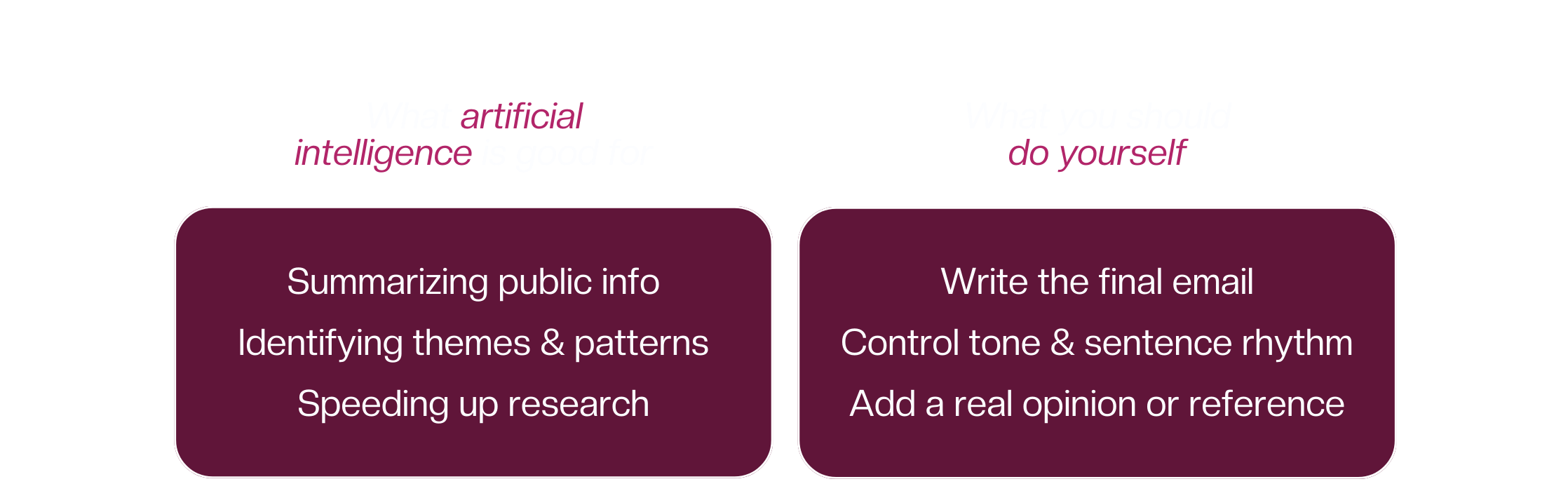
Used well, AI can summarize public information, identify themes, and speed up preparation. Used poorly, it produces emails that feel synthetic—and recipients can sense that instantly.
A smart compromise:
- Use AI to gather and structure insights.
- Write the final email yourself.
- Add one unmistakably human element: an opinion, a reference, or a natural sentence rhythm.
If your email feels machine-written, trust is lost before attention is gained.
Final Thoughts: Cold Email Best Practices for 2026
Cold email doesn’t need more volume in 2026. It needs better judgment.
Adam Goldfarb’s approach is a reminder that effective outreach isn’t about hacks—it’s about care. Slower lists, deeper research, shorter emails, and a human voice are what separate meaningful outreach from inbox noise.
If there’s one takeaway to carry forward, it’s this: good cold email respects the recipient’s time and intelligence. Do that consistently, and replies follow naturally.
That’s the anti–cold emailer playbook—and it’s exactly what modern outreach needs.